


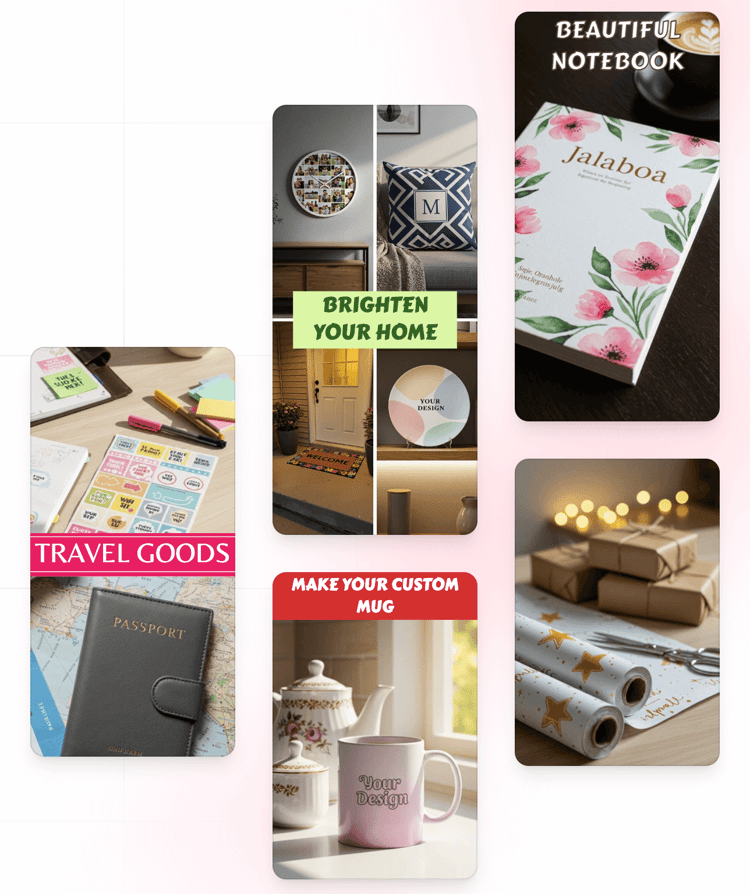
On most platforms, the link on a pin just decides where people land. On Zazzle it also decides how much you earn from the sale. Since April 2025, Zazzle pays creators very differently depending on who brought the buyer in and which kind of link they used. Get the link right before you make a single pin.
How Zazzle's Ambassador Program changes your Pinterest links
Zazzle replaced its old Associates program with the Ambassador Program on April 1, 2025. It's free and existing Associates were moved over automatically (Zazzle Creator FAQ). There are now two link types (Zazzle Help: Royalties and Referrals):
- Self-Promotion Links are plain URLs to your own products, stores or collections, with no
rf=parameter. Zazzle recognizes the visit as yours and pays 35-50% of the net sale in total (royalty plus referral), depending on the product department. - Cross-Promotion Links contain
?rf=followed by your Ambassador ID. They're for promoting other creators' products and pay a flat 15% referral commission.
The trap: if you add your rf= ID to links for your own products, the FAQ says you only get the standard 15%. So on Pinterest, pin your own products with clean URLs.
Why it's worth driving your own traffic at all: when a sale comes from Zazzle's own marketing or another Ambassador's link, Zazzle deducts a Marketing Royalty Fee of 35-50% of your royalty, depending on the department. Sales you refer yourself avoid that cut.
Referrals are tracked for 45 days, and Zazzle protects the first referrer for 14 days so a later click doesn't take the credit (Zazzle Help: Royalties and Referrals). That suits Pinterest, where people often save something and come back later.
What Pinterest allows (and doesn't) for a Zazzle store
You can't claim zazzle.com as your website, so there's no Pinterest tag and no catalog for your store. Pinterest only allows claiming domains you own and can edit (Pinterest Help: Claim your website). Every pin is a regular pin with a link. A Pinterest business account is still worth having for the analytics.
If you pin other creators' products with Cross-Promotion Links, those are affiliate links in Pinterest's eyes. Pinterest's commercial content guidelines say to disclose them (#ad or the paid partnership label), keep affiliate pins original and not in large volumes, and be transparent about where links go. They also note that some link shorteners aren't supported, so use the full Zazzle URL.
Zazzle's side has rules too. Its FAQ allows sharing on Pinterest but warns that spamming or misleading promotions can lead to account suspension (Zazzle Help: Ambassador Program FAQs). The Ambassador agreement prohibits misrepresenting your relationship with Zazzle and using Zazzle's trademarks to earn referrals, so don't name your Pinterest profile or boards in a way that looks like an official Zazzle account.
Step by step: pinning your Zazzle products
1. Use the Share button or copy a clean URL
Zazzle product pages have a Share button with a Pinterest option. It adds your Ambassador ID automatically for other creators' products and leaves it off for your own (Zazzle Help: How to share your product). If you build pins yourself, copy the product URL (it looks like zazzle.com/your_product_title-256123456789012345) and check there's no rf= on it. Your store page (zazzle.com/store/yourstore) and collections also count as Self-Promotion Links.
2. Fix titles and tags on Zazzle first
Zazzle allows 10 tags per product, recommends titles of at least three words or 20 characters, and descriptions of around 300 characters or more (Zazzle Help: Title, description and tagging best practices). Good product text there gives you good raw material for the pin and helps once the visitor lands.
3. Pin occasions, not just products
If you sell invitations, cards, stationery or personalized gifts, people usually search by event: "boho bridal shower invitation", "custom teacher gift", "50th birthday party decorations". Build boards around occasions and themes, and write pin titles in those terms. Check phrasing with Pinterest search suggestions, Pinterest Trends or our Pinterest keyword research tool. Keep the important words in the first 40 characters (titles can be up to 100).
4. Show the personalization
If a product is customizable, the pin should show it filled in with realistic example text, so people see what they'd get. A 2:3 vertical image (1000 x 1500 px) is Pinterest's recommended size (Pinterest Help: Pin specs). Zazzle's own product images are often square, so place them on a taller background with a short headline. Adobe Color helps if you want a consistent palette across your pins.
5. Skip old Pinterest tactics
Group boards and hashtag-heavy descriptions were common advice years ago and aren't worth your time now. Consistently creating new pins matters more. Pinterest warns that repeatedly saving the same pins can get you flagged as spam (Pinterest Help: Pin performance and distribution), so make a new design or angle rather than re-pinning. Watch outbound clicks in Pinterest Analytics and compare them with your referred sales on Zazzle.
Doing it manually vs. automating with BlogToPin
Disclosure: BlogToPin is our product.
Manually, each pin means making a vertical image, writing the copy, pasting a clean product URL and scheduling. Pinterest's native scheduler holds 10 pins at a time, up to 30 days ahead (Pinterest Help: Schedule Pins).
One thing to know before automating: Zazzle's creator FAQ says automated tools that scrape Zazzle data, such as browser extensions, are prohibited and can lead to account termination or withheld earnings (Zazzle Creator FAQ). So for Zazzle, the safest approach is to supply your own images and links rather than having any tool crawl your product pages.
BlogToPin supports that. You can upload your own product images, or import a CSV with an image URL and an outbound URL per pin (plus optional title, description, board and date; blank titles and descriptions are written by AI). BlogToPin then designs pin variations, writes Pinterest copy and schedules them. Use your clean Self-Promotion URLs as the outbound links.
Plans start at $39/month, or $25/month billed annually. There's no free trial, but you can generate and preview pins before paying. See the Zazzle use case page.
If you also sell on Redbubble, the approach there is different (tracked links and Redbubble's promo images), covered in how to create pins for a Redbubble shop. The free Pinterest pin maker and title and description generator are fine for one-off pins.


